Jump to HeaderJump to Main ContentJump to Footer
Michigan State University
Digital Experience Studio

University Communications and Marketing

Digital Experience Studio

  • Experience Program
    • Website Project Process
    • Working with a Vendor
    • Glossary
    • Taxonomy Data Dictionary
  • |
  • Experience Design
    • Website Strategy
    • Website Structure
    • Information Architecture and Navigation
    • User-Centered Design Conventions
    • Common UX Issues
    • Enterprise Design System
    • Content Planning
    • Creating Accessible Content
    • Taxonomy and Filters
  • |
  • Website Technology
    • Web Standards
    • Search Engine Optimization
    • Cascade CMS
    • Sitecore CMS
    • Content Hub Overview
    • Content Hub DAM
    • Content Hub Operations

    SitecoreAI

    Sitecore user login
  • |
  • Social Media
    • Alt Text Bookmarklet
    • Meta Ad Pixel
    • Social Media and Web Integration
    • Sprinklr

    Sprinklr

    Sprinklr user login
  • |
  • Analytics
    • Google Analytics (GA4)
    • Testing
    • Data Visualization

    Google Analytics

    Google Analytics user login
  • |
  • News and Events
    • News and Updates
    • Events and Trainings
Digital Experience Studio

University Communications and Marketing

  • Experience Program
  • Experience Design
  • Website Technology
  • Social Media
  • Analytics
  • News and Events

< Experience Program

  • Website Project Process
  • Working with a Vendor
  • Glossary
  • Taxonomy Data Dictionary

< Experience Design

  • Website Strategy
  • Website Structure
  • Information Architecture and Navigation
  • User-Centered Design Conventions
  • Common UX Issues
  • Enterprise Design System
  • Content Planning
  • Creating Accessible Content
  • Taxonomy and Filters

< Website Technology

  • Web Standards
  • Search Engine Optimization
  • Cascade CMS
  • Sitecore CMS
  • Content Hub Overview
  • Content Hub DAM
  • Content Hub Operations

SitecoreAI

Sitecore user login

< Social Media

  • Alt Text Bookmarklet
  • Meta Ad Pixel
  • Social Media and Web Integration
  • Sprinklr

Sprinklr

Sprinklr user login

< Analytics

  • Google Analytics (GA4)
  • Testing
  • Data Visualization

Google Analytics

Google Analytics user login

< News and Events

  • News and Updates
  • Events and Trainings
Digital Experience Studio > Website Technology > Sitecore CMS > Sitecore Component Guide >

Events

MSU Tools and Resources

  • A to Z Index
  • Find People
  • Email
  • Tech Support
  • Social Media Directory

Communications Resources

  • University Communications and Marketing
  • University Trademarks and Licensing
  • MSU Brand Studio
  • MSU Editorial Style Guide
  • MSU Photos

Contact us

517-355-7505

Address

Michigan State University 408 West Circle Drive East Lansing, MI 48824

Follow Us

  • Visit our Facebook page
  • Visit our page on X
  • Visit our Instagram page
  • Visit our LinkedIn page
  • Visit our YouTube page
  • Visit our TikTok page

If you're having accessibility issues, please let us know.

Know MoreTransparency Reporting: Budget & Salary/Compensation
  • Contact Information|
  • Site Map|
  • Privacy Statement|
  • Site Accessibility|
  • Call MSU: (517) 355-1855|
  • Visit: msu.edu|
  • Notice of Nondiscrimination|

SPARTANS WILL|© Michigan State University|

Events

The Events feature provides a means for adding calendar events content to a website to promote awareness. Each Events item is a web page built on the Event Page template. The Events items within a website are automatically grouped into a filterable and searchable Events Listing Page on the website. Events items also can be featured in components on other web pages. See the pages below for information on how to work with the Events feature in SitecoreAI.
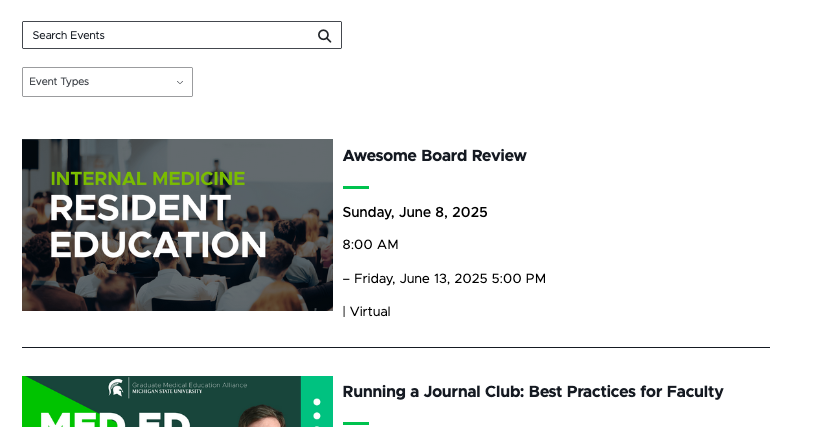
Screenshot of an events listing page with a search box and event type filter visible
Figure 1: Example of an Events Listing Page.

Feature Information

  • Usage
    • The Events feature can be used to add event promotion content to a calendar listing on a website.
    • All Events items use the Event Page layout.
    • Each Events item is associated with a specific date.
    • Events items display in a listing view that can be filtered by event type, event category, date or date range and unit.
  • Best Practices
  • Frequently Asked Questions

    How does a unit get Events added to a website?

    To request the Events feature be activated on a unit website, fill out and submit this form. 

    The digital experience program manager will generate a ticket, and a member of the University Communications and Marketing platforms group will activate the feature on the website. 

    Using Events in Sitecore XM Cloud

    Event Page

    Each Events item creates an Event Page. These pages have event-specific data template fields to enhance a website visitor’s experience in exploring content. 

    Explore the layout

    Events Taxonomy

    Units can create custom taxonomy options to enable search and filters based on Event Types and Backend Tags. Units can also use the global Event Audiences and Event Categories filter options.

    Enable event tagging

    Event Listing Page

    Event Listing Pages are automatically populated listing views of the Event Pages on a website. These listing pages are filterable using the data template taxonomy and date fields, enabling website visitors to find the event they’re interested in exploring. As Event Pages are added to the website and published, they’ll automatically populate into the site’s Events Listing Page. As event dates pass, the event will fall off the display of the listing page (though past events can be found using a toggle on the date filter).

    Showcase events


    Documentation updated: June 29, 2026

    Is there an issue with this documentation? Report it here.

    • Assign open graph data to each event in Content Editor. This ensures that event pages are optimized when sharing to social media, including a proper title, description and thumbnail image.
    • Fill out all relevant taxonomy fields for each event. This ensures that event filters accurately represent the full available collection of event content matching a selected filter parameter.
    • Ensure all staff are familiar with how taxonomy fields are to be used for the unit so that event tagging is consistent. Consider creating internal documentation for how recurring events should be tagged.
    • Units should limit their selected options within a taxonomy category (e.g., Event Types, Event Categories) to 10 selections across the site. 
  • Expected Behavior
    • Event Listing Pages can be viewed in a list layout. There is not a calendar grid view. This is intentional; grid views make for a challenging mobile user experience for event content.
    • All event items appear on the listing page. Pagination appears after a designated number of events, as selected in the events widget presentation settings.
    • The listing page can be filtered by Event Category, Event Type, Department, date or date range.
    • Past events do not display in the listing page but can be searched for using a toggle option in the date filter calendar. 
  • Related Information
  • Similar features:

    • News — News behaves in a similar way to Events items. Events and News features are activated together but can be used independently.

    Related components:

    • Featured News and Events — The Featured News and Events component includes several variants, allowing content authors to feature news and/or events, using either manual or automatic curation, on a web page.
    • Grid Container — Events can be featured in a Grid Container by including an image and link to the Event Details Page within a grid container cell. This must be manually curated and updated.
    • Mixed Content — Events can be featured in a Mixed Content Container by including an image and link to the Event Details Page within a container cell. This must be manually curated and updated.
    Can a grid view be added to the Events Listing Page?

    No, the Events Listing Page would not provide a quality user experience on mobile devices when events are displayed in a grid. 

    Can past events be viewed on the Events Listing Page?

    Yes. Use the toggle on the date range filter.

    How many events are listed on an Events Listing Page?

    Content authors can adjust the number of events listed on a page using pagination controls in the Events Listing presentation settings. 

    Can a unit customize the taxonomy (i.e., filter labels and options) for the events on the website?

    Yes and no. Units can customize the options within some filter categories, but not the categories themselves. This is because creating or modifying categories requires custom development. If a unit has a need for a new filter category, contact University Communications and Marketing to discuss your use case. There may be unit expense related to the custom development of additional category filters. University Communications and Marketing will discuss options with the unit prior to moving forward with any work that may lead to expenses. 

    Event Types are site-specific. University Communications and Marketing has provided a recommended set of Event Types to get units started. See “Events Taxonomy” for instructions and additional information. 

    Backend Tags and Unit Tags are site-specific and shared across Events, News and People Directory features. These can be used for search, but not as filters.

    Event Categories and Event Audiences are a standardized global list within the system. This was done to support development of a future campus events calendar. Departments is also a standardized list within the system. If a department or unit is missing, please contact University Communications and Marketing to request that it be added. The platforms group will investigate. 

    Why is a specific option not appearing in a drop-down filter?

    The filters are contextual and additive. Options will only appear in the drop-downs if there is an event tagged that matches the applied filters. If multiple filters are in use, the available options in the second (or third, etc.) filters will automatically update to contain only what is available in content on the site that already meets the other applied active filters. 

    Why can’t a user see Events items in their site’s Content Tree?

    This typically occurs when “Hidden Items” and “Buckets” are not selected to display in Content Editor. 

    Screenshot of the View tab in the Content Editor navigation ribbon showing that Content Tree, Entire Tree, Hidden Items and Buckets are checked so they will display
    Figure 2: The “Hidden Items” and “Buckets” options are checked in the View tab of the Content Editor navigation ribbon.

    In Content Editor:

    1. Click the “View” tab on the navigation ribbon.
    2. Check Hidden Items and Buckets.
    3. Items should now be visible in the Content Tree.

    If you’re still experiencing issues, contact University Communications and Marketing to generate a support ticket. Include the website URL and details regarding the Events items you’re expecting to see. 

    Where did a newly created Event Page move to? 

    Event Pages are automatically bucketed by year and month, based on the Start Time field set on the page. When a content author creates an Event Page, it will be bucketed with today’s date. If the author changes the Start Time field in the Event section of Content Editor, the page will move to that date’s corresponding bucket. 

    Can events be scheduled to publish at a specific later date and time?

    Not currently. This is an enhancement that University Communications and Marketing may add in the future. For now, users can set a timeframe for when an Event Page is “publishable” to ensure it isn’t accidentally published too early, but the Event Page must be manually published during the “publishable” window. 

    See “Publishing Content with Workflows” for instructions. 

    Note: The “Put Up On Site” and “Take Down” data fields are not currently operational.