Jump to HeaderJump to Main ContentJump to Footer
Michigan State University
Digital Experience Studio

University Communications and Marketing

Digital Experience Studio

  • Experience Program
    • Website Project Process
    • Working with a Vendor
    • Glossary
    • Taxonomy Data Dictionary
  • |
  • Experience Design
    • Website Strategy
    • Website Structure
    • Information Architecture and Navigation
    • User-Centered Design Conventions
    • Common UX Issues
    • Enterprise Design System
    • Content Planning
    • Creating Accessible Content
    • Taxonomy and Filters
  • |
  • Website Technology
    • Web Standards
    • Search Engine Optimization
    • Cascade CMS
    • Sitecore CMS
    • Content Hub Overview
    • Content Hub DAM
    • Content Hub Operations

    SitecoreAI

    Sitecore user login
  • |
  • Social Media
    • Alt Text Bookmarklet
    • Meta Ad Pixel
    • Social Media and Web Integration
    • Sprinklr

    Sprinklr

    Sprinklr user login
  • |
  • Analytics
    • Google Analytics (GA4)
    • Testing
    • Data Visualization

    Google Analytics

    Google Analytics user login
  • |
  • News and Events
    • News and Updates
    • Events and Trainings
Digital Experience Studio

University Communications and Marketing

  • Experience Program
  • Experience Design
  • Website Technology
  • Social Media
  • Analytics
  • News and Events

< Experience Program

  • Website Project Process
  • Working with a Vendor
  • Glossary
  • Taxonomy Data Dictionary

< Experience Design

  • Website Strategy
  • Website Structure
  • Information Architecture and Navigation
  • User-Centered Design Conventions
  • Common UX Issues
  • Enterprise Design System
  • Content Planning
  • Creating Accessible Content
  • Taxonomy and Filters

< Website Technology

  • Web Standards
  • Search Engine Optimization
  • Cascade CMS
  • Sitecore CMS
  • Content Hub Overview
  • Content Hub DAM
  • Content Hub Operations

SitecoreAI

Sitecore user login

< Social Media

  • Alt Text Bookmarklet
  • Meta Ad Pixel
  • Social Media and Web Integration
  • Sprinklr

Sprinklr

Sprinklr user login

< Analytics

  • Google Analytics (GA4)
  • Testing
  • Data Visualization

Google Analytics

Google Analytics user login

< News and Events

  • News and Updates
  • Events and Trainings
Digital Experience Studio > Website Technology > Sitecore CMS > Sitecore Component Guide > Program Finder >

Program Listing Page

Michigan State University

MSU Tools and Resources

  • A to Z Index
  • Find People
  • Email
  • Tech Support
  • Social Media Directory

Communications Resources

  • University Communications and Marketing
  • University Trademarks and Licensing
  • MSU Brand Studio
  • MSU Editorial Style Guide
  • MSU Photos

Contact us

517-355-7505

Address

Michigan State University 408 West Circle Drive East Lansing, MI 48824

Follow Us

  • Visit our Facebook page
  • Visit our page on X
  • Visit our Instagram page
  • Visit our LinkedIn page
  • Visit our YouTube page
  • Visit our TikTok page

If you're having accessibility issues, please let us know.

Know MoreTransparency Reporting: Budget & Salary/Compensation
Michigan State University
  • Contact Information|
  • Site Map|
  • Privacy Statement|
  • Site Accessibility|
  • Call MSU: (517) 355-1855|
  • Visit: msu.edu|
  • Notice of Nondiscrimination|

SPARTANS WILL|© Michigan State University|

Program Listing Page

Adding the Program Finder feature to a website creates a Program Listing Page, which automatically displays Program Cards entries in a list view. These are filterable and searchable using the taxonomy and metadata fields that make up the Program Details Page data template. 
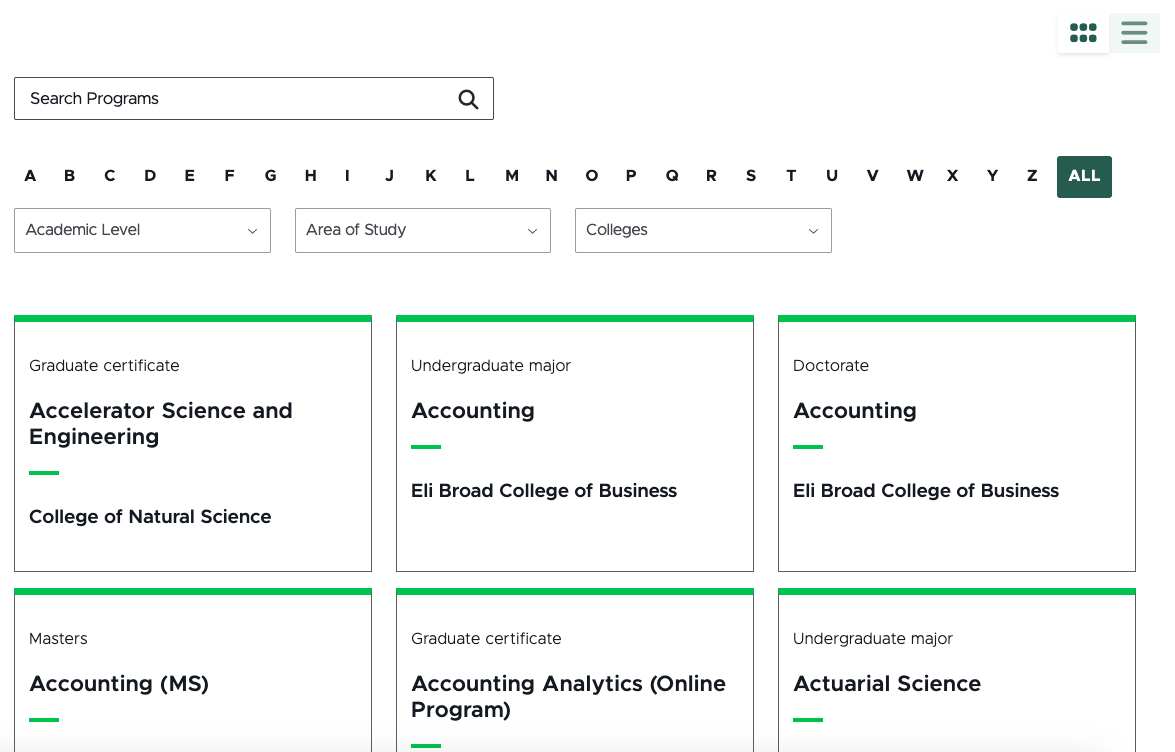
A screenshot of a Program Listing Page on the Office of Admissions website
Figure 1: A screenshot of a Program Listing Page. 

Frequently Asked Questions

How does a unit get Program Finder added to a website?

To request the Program Finder feature be activated on a unit website, fill out and submit this form. 

The digital experience program manager will generate a ticket, and a member of the University Communications and Marketing platforms group will activate the feature on the website. 

Template Data

Many of the data template fields that make Program Listing Pages so powerful are only available in Content Editor. The data template fields are found on the Content tab of the Listing Page in Content Editor. 
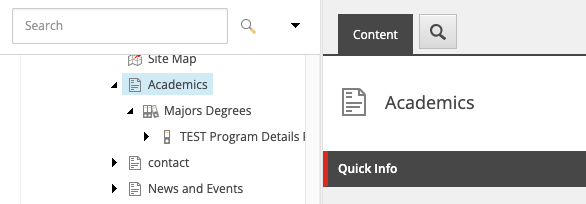
The Content tab has been selected on the Academics page, which serves as the Program Listing page.
Figure 2: The Content tab has been selected on the Academics page, which serves as the Program Listing page in this website.
Content Data Fields

Title (single-line text)

  • Required field.
  • This is the page title displayed as the H1.
  • It must be unique and should be 50-70 characters for best search engine optimization practices. 

Browser Title (single-line text)

  • Optional field.
  • This title appears on the browser’s tab or top bar.
  • If no text is placed here, the browser tab will show the Page Title.

Instructions for Use

Note: The Program Finder feature must be activated on the website by University Communications and Marketing before it can be used. 

Tip for using Content Editor: Most users have found working in Content Editor to create items to be the easiest for many tasks related to the Program Listing page. Users must have “Hidden Items” and “Buckets” checked in the View tab of the Content Editor navigation ribbon to view People-related items in the Content Tree.

Request Program Finder feature activation

To request the Program Finder feature be activated on a unit website, fill out and submit this form. 

The digital experience program manager will generate a ticket, and a member of the University Communications and Marketing platforms group will activate the feature on the website. 

Tool Use Guide


Documentation updated: June 11, 2026

Is there an issue with this documentation? Report it here.

Can grid (or list) view be turned off on the Program Listing Page?

No, the Program Listing Page offers both grid and listing views to provide website visitors with their optimal user experience. 

Are images required on Program Cards?

No, images are optional. 

How many Program Cards are listed on a Program Listing Page?

Content authors can adjust the number of Program Cards listed on a page using pagination controls in the Program Listing presentation settings. 

Can a unit customize the taxonomy (i.e., filter labels and options) for the people on the website?

No, the taxonomies were developed to be global for all campus units, in partnership with the Office of Admissions. If a unit has a suggestion for a change, contact University Communications and Marketing to discuss the use case. 


Why is a specific option not appearing in a drop-down filter?

The filters are contextual and additive. Options will only appear in the drop-downs if there is a Program Card tagged that matches the applied filters. If multiple filters are in use, the available options in the second (or third, etc.) filters will automatically update to contain only what is available in content on the site that already meets the other applied active filters. 

Metatags Data Fields

Meta Description (single-line text)

  • Add a description of the page to this field.
  • This assists with search engine optimization and provides users a quick summary of what they can expect to find on the page. See “Search Engine Optimization” for additional information.

Meta Keywords (single-line text)

  • Add keywords to this field to guide search engines on what this page content is about. See “Search Engine Optimization” for additional information. 

No Index (checkbox)

  • Check this box if search engine or AI crawlers should not index the page.

No Follow (checkbox)

  • Check this box if search engines should not follow links to the page.

Canonical (single-line text)

  • If the same content appears on multiple pages or websites, include the full URL of the web page that search engines should treat as canon (i.e., most important). 
Open Graph Data Fields

Open Graph Title (single-line text)

  • This field controls the headline that appears when the Program Listing Page is shared via social media, web search, texting, etc. 

Open Graph Type (droplist)

  • This setting defaults to website for Program Listing Pages.

Open Graph Image (image selection)

  • This field controls the thumbnail image that accompanies the Program Listing Page when it is shared via social media, web search, texting, etc.

Open Graph URL (single-line text)

  • This field controls the open graph tag related to the page being shared, indicating the canonical URL of the web page to define how a shared link is displayed. 
Navigation Data Fields

Hide Breadcrumb on Page (checkbox)

  • Checking this box will remove the breadcrumb link trail from the top of the Program Listing Page.

Check to hide in navigation filters (checkboxes)

  • Breadcrumb Navigation — Checking this box will hide the page from inclusion in breadcrumb navigation components, if present on a page.
  • Sidebar Navigation — Checking this box will hide the page from inclusion in sidebar navigation components, if present on a page.
  • Sitemap Navigation — Checking this box will hide the page from inclusion in the sitemap. 
Presentation Control Properties

Note: Fields not listed below should not be edited without the assistance of University Communications and Marketing. 

Site Names (single-line text)

  • Enter the name of the site containing the academic program data.
  • This is the system name exactly as it appears in the Content Tree in Sitecore

Facets  (single-line text)

  • Enter desired facets in the box, exactly as written, and separated by a comma.
  • Options:
    • academic_level
    • program_location
    • program_format
    • colleges
    • area_of_study
    • taxonomy_college_department

Items Per Page (numeric)

  • Enter a whole number to control the volume of program cards that appear on a listing page.
  • If the website program finder contains more programs than this limit, pagination will automatically be enabled.
Rename the Program Listing Page

By default, activating the Program Finder feature adds a page titled “Academics” to the top level of the site’s Content Tree. This page is an automatically generated listing page that will populate with the Program Details items. 

Users can rename this “Academics” page in the same way that other pages are renamed. 

See “Naming a Page” for instructions. 

Move the Program Listing Page

By default, activating the Program Finder feature adds a page titled “Academics” to the top level of the site’s Content Tree. This page is an automatically generated listing page that will populate with the Program Details items. 

Users can move the “Academics” page in the same way that other pages are moved within the Content Tree. 

Note: Take care to ensure that any navigational components are updated to accurately reflect page locations, as needed.

Add additional content to the Program Listing Page

Users can add select additional content components to the Program Listing Page in Page Builder. See “Add and Delete Components” for additional information. 

Be sure to carefully consider the mobile user experience. Adding too much content above the listing widget will push the listing filters down on a page and may make it so that website visitors do not realize there is filterable program content on the page. 

If a user experiences issues while using specific components on the Program Listing Page, they should report the issue to University Communications and Marketing. Not all component combinations have been tested.


Create and edit filters on Listing Page

Filters included on the Program Listing Page are controlled using widget settings in Content Editor. 

To change included filters:

  1. Open Content Editor.
  2. Locate the Program Listing Page. The default location for this page is found by expanding the MSU node, website name, Home node, Academics node, and click to select the Majors Degrees page.
  3. On the navigation ribbon, click the Presentation tab.
  4. Click Details to open the Layout Details window.
  5. Click the Final Layout tab within the Layout Details window.
  6. Click the Program List link under MSU Headless Layout Controls.
  7. In the Facets field, list the desired filter facets. Separate facets by a comma. Available facets include:
    1. academic_level
    2. program_location
    3. program_format
    4. colleges
    5. area_of_study
    6. taxonomy_college_departments
  8. Click OK.
  9. Click Save.
  10. To send changes to the publication workflow, click the Review tab and Submit on the navigation ribbon.

Note: Users should not edit settings other than the fields described above without specific direction from the University Communications and Marketing platforms group. Adjusting the other fields, such as the RFK ID field, will cause issues with the results displaying on the page. 

Adjust the pagination settings on Listing Page

The number of individuals included on the Program Listing Page is controlled using widget settings in Content Editor. 

To change included filters:

  1. Open Content Editor.
  2. Locate the Program Listing Page. The default location for this page is found by expanding the MSU node, website name, Home node, Academics node, and click to select the Majors Degrees page.
  3. On the navigation ribbon, click the Presentation tab.
  4. Click Details to open the Layout Details window.
  5. Click the Final Layout tab within the Layout Details window.
  6. Click the Program List link under MSU Headless Layout Controls.
  7. Enter a number in the Items Per Page field. This number represents the number of Program Cards listed on each page in the Programs Listing.
  8. Click OK.
  9. Click Save.
  10. To send changes to the publication workflow, click the Review tab and Submit on the navigation ribbon.
Publish the Program Listing Page

Publish the Program Listing Page like any other page in Sitecore. See “Publishing Content with Workflows” for more information.

Note: The Program Listing page will not show data until it is published and the listed items below it are published.